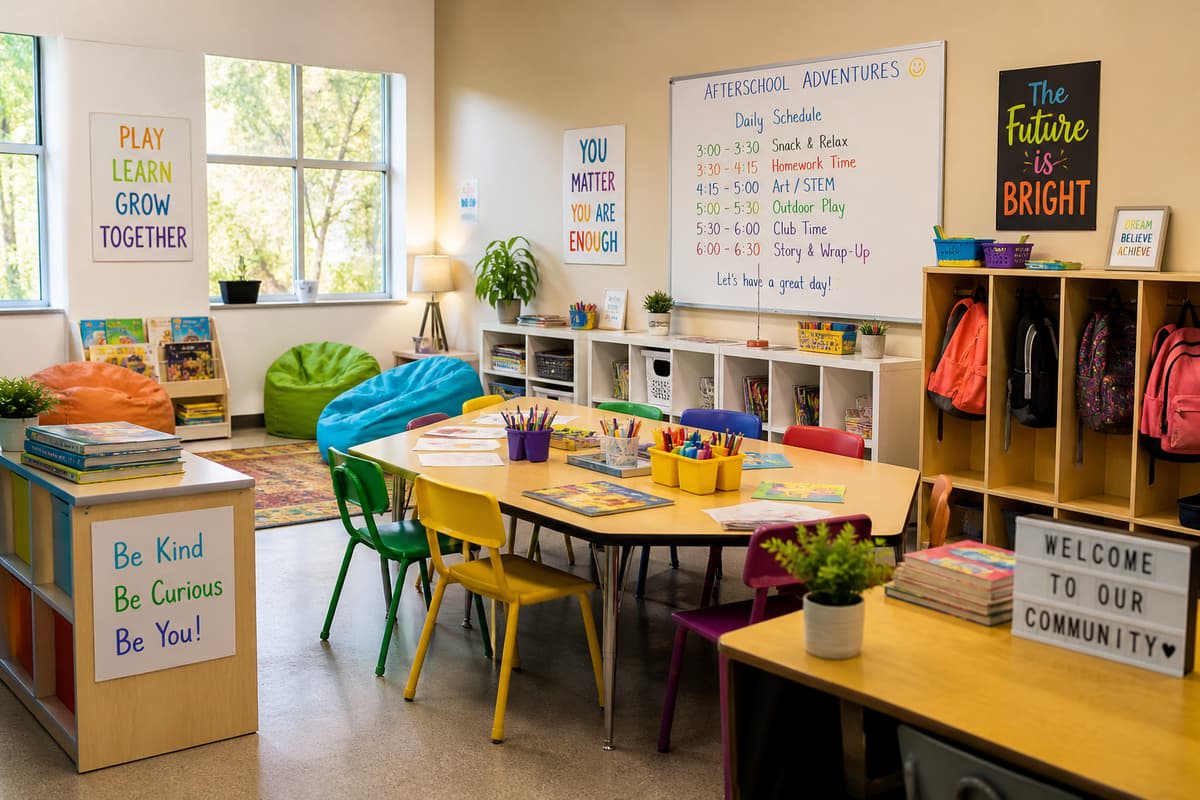
How to start an afterschool program
How to start an afterschool program
$10,000 – $50,000+ startup cost

What an Afterschool Program Is and Why It Matters
An afterschool program is a structured, supervised activity that takes place outside of regular school hours, typically between 2 PM and 6 PM. These programs give students a safe environment to continue learning, explore new interests, build social skills, and stay engaged while parents finish their workday. Starting one requires thoughtful planning across several areas: identifying community needs, securing funding, hiring qualified staff, developing curriculum, and meeting licensing requirements.
| Key Element | What It Involves |
|---|---|
| Community needs assessment | Surveying families, schools, and local organizations to identify gaps |
| Program type selection | Choosing between academic support, enrichment, sports, STEM, arts, or blended models |
| Startup funding | $10,000 – $50,000+ depending on size and scope |
| Licensing and compliance | State childcare licensing, background checks, facility inspections |
| Staffing | Program director, group leaders, volunteers, and specialists |
| Facility setup | Securing space at a school, community center, or private location |
| Curriculum design | Building age-appropriate, goal-driven programming |
The demand for afterschool programs continues to grow. According to the Afterschool Alliance, for every child in an afterschool program in the United States, three more are waiting to get in. That gap represents a significant opportunity for educators, nonprofit leaders, community organizations, and entrepreneurs who want to serve families in their area.
Whether you plan to operate a small homework help club at a local church or a full-scale enrichment center serving hundreds of students, the foundational steps remain largely the same. This guide walks through every stage of launching a successful afterschool program from scratch.
Types of Afterschool Programs
Before you write a single grant application or lease a space, you need to decide what kind of program you want to run. The type you choose shapes everything from staffing needs to budget size to the families you attract. Afterschool programs generally fall into several broad categories, and many successful operations blend elements from more than one.
| Program Type | Focus Area | Best For |
|---|---|---|
| General afterschool care | Supervision, free play, snacks, homework time | Families needing reliable daily coverage |
| Academic enrichment | Tutoring, homework help, test prep, reading support | Students needing extra academic support |
| STEM programs | Robotics, coding, science experiments, engineering projects | Students interested in building and problem-solving |
| Creative arts | Visual art, music, theater, dance, film | Students who enjoy creative expression |
| Sports and fitness | Organized sports, martial arts, yoga, movement games | Active students who thrive with physical outlets |
| Life skills | Cooking, financial literacy, leadership, project management | Students building practical, real-world competencies |
General Afterschool Care
General afterschool care programs focus primarily on supervision and consistency. They run from school dismissal until around 6 PM and provide a safe, predictable environment. Activities tend to be low-structure: board games, outdoor play, snack time, and movies. Organizations like the YMCA and Boys & Girls Club have built well-known models around this format.
This type of program is the simplest to launch because it requires less specialized staffing. It appeals to the broadest audience of families who need a reliable place for their children every afternoon.
Enrichment Programs
Enrichment programs are built around a specific subject or skill set. Rather than offering general supervision, they deliver structured learning experiences led by instructors with relevant expertise. Sessions typically last one to two hours and may meet one to five days per week.
STEM programs, for example, might guide students through 3D printing projects, circuit builds, or chemistry experiments. Creative arts programs could include pottery, digital music production, or playwriting. The key distinction is intentional instruction with clear learning outcomes.
Blended Models
Many of the most successful afterschool programs combine multiple elements. A student might start the afternoon with homework help, transition to a STEM enrichment session, and finish with free play or outdoor time. Blended models allow programs to serve diverse needs within a single operation and appeal to families looking for both supervision and meaningful learning.
Step 1: Conduct a Community Needs Assessment
The single most important step before launching an afterschool program is understanding what your community actually needs. A well-executed needs assessment prevents you from building a program that nobody uses. It also strengthens grant applications, since funders want evidence that your program addresses a real, documented gap.
| Assessment Activity | Purpose |
|---|---|
| Parent surveys | Identify scheduling needs, preferred activities, and willingness to pay |
| School administrator interviews | Understand academic gaps, behavior trends, and facility availability |
| Community data review | Analyze demographics, poverty rates, crime statistics, and existing programs |
| Student focus groups | Learn what activities and subjects interest the target age group |
| Competitor analysis | Map existing afterschool options and identify underserved areas or populations |
Survey Families and Schools
Create a simple survey for parents and distribute it through local schools, community centers, and social media. Ask about their current afterschool arrangements, the hours they need coverage, the activities their children enjoy, and what they can afford to pay. Even 50 to 100 responses can reveal clear patterns.
Meet with school principals and counselors as well. They can tell you which students are most at risk of falling behind academically, which neighborhoods lack afterschool options, and whether the school would be open to partnering on space or referrals.
Review Community Data
Look at census data, free and reduced lunch percentages, juvenile crime statistics, and academic performance data for schools in your target area. These numbers tell a story about where the need is greatest and help you tailor your program's mission. High concentrations of working families with limited income often signal the strongest demand for affordable afterschool care.
Identify Gaps in Existing Services
Research what programs already exist in your area. If three organizations already offer general afterschool care but none provides STEM enrichment, that gap is your opportunity. If existing programs have long waitlists, the need for more capacity is already proven. Document these findings carefully; they become the foundation of your program proposal.
Step 2: Define Your Program Structure
Once you understand community needs, you can begin designing your program's framework. This includes defining your mission, choosing an age range, setting a schedule, and selecting a location. Clear structure at this stage saves significant time and money later.
| Structural Element | Key Decisions |
|---|---|
| Mission statement | What problem does your program solve? What outcomes do you promise? |
| Age range | Elementary (5 to 10), preadolescent (10 to 14), teen (14 to 18), or multiple groups |
| Schedule | Daily vs. select days, school year only vs. year-round, session length |
| Capacity | Number of students per session, staff-to-student ratios |
| Location | School facility, community center, faith-based building, leased commercial space |
Write a Clear Mission Statement
Your mission statement should be one to two sentences that explain who you serve, what you offer, and what outcomes families can expect. For example: "Our program provides hands-on STEM enrichment for elementary students in underserved neighborhoods, building problem-solving skills and academic confidence through project-based learning."
This statement drives every subsequent decision. It guides curriculum choices, informs hiring, and anchors your marketing. Revisit it often as you build out the details.
Choose Your Target Age Group
Children at different developmental stages have very different needs. Elementary-age students (5 to 10) thrive with simple rules, frequent adult interaction, creative play, and activities that build both fine and gross motor skills. They have high energy and shorter attention spans, so activities should rotate frequently.
Preadolescents (10 to 14) need more autonomy, peer interaction, and opportunities to explore ethics and values. They respond well to project-based learning, leadership roles, and connections to real-world experiences.
Teens (14 to 18) demand genuine choice, privacy, and relevance. Effective teen programs incorporate career exploration, mentorship, community service, internships, and real work experience. Programs that treat teens like younger children will struggle with retention.
Serving multiple age groups within the same program is possible but requires separate activity plans, dedicated spaces, and appropriate staff-to-student ratios for each group. Many new programs find it easier to start with a single age range and expand later.
Select a Location
Your facility is one of the largest cost drivers and logistical considerations. The most common options include:
- School facilities: Partnering with a school district to use classrooms, gyms, and cafeterias after hours is often the most affordable option. It also eliminates transportation barriers since students are already on site.
- Community centers: Libraries, recreation centers, and parks departments frequently have available space at low or no cost for youth-serving organizations.
- Faith-based buildings: Churches, synagogues, and mosques often have fellowship halls and classrooms that sit empty on weekday afternoons.
- Leased commercial space: Renting your own space gives maximum control but comes with the highest cost. Budget $1,000 to $5,000+ per month depending on your market.
| Location Type | Estimated Monthly Cost | Key Advantage |
|---|---|---|
| School facilities | $0 – $500 | Students already on site; no transportation needed |
| Community centers | $0 – $1,000 | Low cost; built-in community connections |
| Faith-based buildings | $0 – $800 | Available space on weekday afternoons |
| Leased commercial space | $1,000 – $5,000+ | Maximum control over layout and branding |
Whatever space you choose, ensure it meets local building codes, has adequate restrooms, offers indoor and outdoor activity areas, and provides safe drop-off and pick-up zones.
Step 3: Secure Funding
Funding is the engine that keeps an afterschool program running. Most programs rely on a combination of revenue sources rather than a single stream. Your startup costs will vary widely based on program size, location, and scope, but planning for $10,000 to $50,000 in initial expenses is realistic for most small to mid-sized programs.
| Funding Source | Typical Contribution | Notes |
|---|---|---|
| Federal grants (21st CCLC) | $50,000 – $200,000+ per year | Largest federal funding source for afterschool; competitive application |
| State and local grants | $5,000 – $100,000 per year | Varies significantly by state |
| Foundation grants | $2,500 – $50,000 per year | Family foundations, community foundations, corporate foundations |
| Parent tuition/fees | $50 – $300 per week per child | Sliding scale options increase accessibility |
| Corporate sponsorships | $1,000 – $25,000+ | Local businesses, especially those with education or youth missions |
| Fundraising events | $500 – $10,000+ per event | Galas, fun runs, auctions, crowdfunding campaigns |
| In-kind donations | Varies | Supplies, food, volunteer hours, facility space |
Federal and State Grants
The 21st Century Community Learning Centers (21st CCLC) program is the largest dedicated federal funding source for afterschool and summer learning. Administered through state education agencies, these grants fund academic enrichment, youth development, and family engagement activities. Awards are competitive and typically require a strong needs assessment, partnership letters, and an evaluation plan.
Beyond 21st CCLC, explore funding through the Child Care and Development Fund (CCDF), Community Development Block Grants (CDBG), and your state's department of education or youth services. Many states also offer dedicated afterschool funding streams. If you are opening a childcare-focused program, you may also want to explore daycare grants available to childcare providers.
Tuition and Fee Structures
If your program charges families, build a fee structure that balances sustainability with accessibility. Full-time afterschool care typically costs families $50 to $300 per week depending on the region. Enrichment-only sessions that meet one or two days per week may charge $15 to $50 per session.
| Program Type | Typical Weekly Cost | Typical Per-Session Cost |
|---|---|---|
| Full-time afterschool care (5 days/week) | $50 – $300 | N/A |
| Enrichment sessions (1–2 days/week) | N/A | $15 – $50 |
Offer a sliding scale or scholarship fund so cost does not become a barrier for the families who need your program most. Accepting childcare subsidies through your state's voucher system can also help fill spots while ensuring revenue. Families may also benefit from the Child and Dependent Care Credit, which can offset afterschool care expenses.
Build a Detailed Budget
Your budget should account for both startup and ongoing operating costs. Common line items include:
- Staff salaries and benefits (typically 60% to 70% of total budget)
- Facility costs: rent, utilities, insurance
- Supplies and materials: curriculum resources, art supplies, sports equipment, technology
- Snacks and meals
- Transportation (if busing students from schools to your site)
- Professional development for staff
- Administrative costs: accounting, software, marketing
- Background checks and licensing fees
Build at least three months of operating reserves into your budget before you open your doors. Grant cycles can be unpredictable, and enrollment may take time to reach capacity.
Step 4: Hire and Train Staff
Your staff determines the quality of your program more than any other single factor. The right team creates a safe, engaging, and enriching environment. The wrong hires create liability, high turnover, and poor outcomes for students.
| Role | Responsibilities | Typical Pay Range |
|---|---|---|
| Program director | Oversees all operations, manages staff, handles budgets and compliance | $40,000 – $65,000 per year |
| Site coordinator | Manages day-to-day programming at a specific location | $30,000 – $45,000 per year |
| Group leaders | Lead activities, supervise students, manage behavior | $12 – $20 per hour |
| Enrichment specialists | Teach specific subjects like STEM, art, music, or sports | $15 – $35 per hour |
| Volunteers | Assist with activities, mentoring, homework help | Unpaid (may receive stipends) |
Staff-to-Student Ratios
Most states mandate specific staff-to-student ratios for licensed childcare programs. Common requirements include:
- Ages 5 to 8: 1 staff member for every 10 to 12 students
- Ages 9 to 12: 1 staff member for every 12 to 15 students
- Ages 13 to 18: 1 staff member for every 15 to 20 students
| Age Group | Required Staff-to-Student Ratio |
|---|---|
| Ages 5 to 8 | 1:10 to 1:12 |
| Ages 9 to 12 | 1:12 to 1:15 |
| Ages 13 to 18 | 1:15 to 1:20 |
Even if your state allows higher ratios, keeping groups smaller leads to better engagement, safer environments, and stronger relationships between staff and students.
Hiring Best Practices
Prioritize candidates who demonstrate genuine enthusiasm for working with young people. Experience in education, youth development, recreation, or social work is valuable, but warmth, patience, and reliability matter just as much. If you are looking for guidance on evaluating candidates, review these childcare interview questions to help identify top talent.
Every staff member and volunteer must pass a comprehensive background check before interacting with students. Many states require fingerprinting, sex offender registry checks, and child abuse clearances. Build the cost and processing time for these checks into your hiring timeline.
Staff Training Essentials
Before your program opens, train all staff in the following areas:
- Child and adolescent development
- Positive behavior management and de-escalation techniques
- Emergency procedures: fire, medical, weather, lockdown
- Mandatory reporting of suspected abuse or neglect
- First aid and CPR certification
- Cultural competency and inclusive practices
- Your program's specific curriculum and daily procedures
Ongoing professional development is equally important. Budget for quarterly training sessions, conference attendance, and peer learning opportunities throughout the year.
Step 5: Design Your Curriculum
A strong curriculum turns an afterschool program from babysitting into a transformative experience. Your curriculum should align with your mission, match your students' developmental needs, and balance structured learning with the relaxation students need after a full school day.
| Curriculum Component | Description |
|---|---|
| Learning objectives | Clear, measurable goals for each activity or unit |
| Activity plans | Detailed lesson guides with materials lists, time estimates, and variations |
| Assessment methods | Informal observations, student portfolios, skill demonstrations, surveys |
| Flexibility | Built-in time for student choice, free play, and unstructured socialization |
| School day alignment | Activities that reinforce classroom learning without duplicating schoolwork |
Curriculum Design Principles
Afterschool learning works best when it feels different from the school day. Students have already spent six or more hours in classrooms, so effective afterschool curricula emphasize hands-on projects, collaborative group work, real-world applications, and student choice. Lectures, worksheets, and rigid seating arrangements rarely succeed in this setting.
Use project-based learning whenever possible. Instead of teaching a lesson about circuits, have students design and build a flashlight. Instead of reading about ecosystems, take students on a nature walk and have them document what they observe. Active, experiential learning drives both engagement and retention.
Sample Daily Schedule
A well-balanced afternoon includes variety, transitions, and downtime. Here is a sample schedule for an elementary program running from 3:00 PM to 6:00 PM:
| Time | Activity |
|---|---|
| 3:00 – 3:15 PM | Arrival, attendance, snack |
| 3:15 – 3:45 PM | Homework help and quiet reading |
| 3:45 – 4:30 PM | Enrichment session (STEM, art, music, etc.) |
| 4:30 – 5:00 PM | Outdoor play and physical activity |
| 5:00 – 5:45 PM | Club time or student-choice activities |
| 5:45 – 6:00 PM | Clean-up, reflection circle, dismissal |
Adjust this framework based on your program's focus. A STEM-centered program might dedicate a longer block to enrichment, while a sports-focused program might front-load physical activity when students have the most energy.
Off-the-Shelf vs. Custom Curriculum
You do not need to build everything from scratch. Many organizations offer ready-made afterschool curricula that have been tested and refined over years. Options include programs from 4-H, NASA STEM Engagement, KidzArt, Engineering is Elementary, and many others. Licensing fees typically run $500 to $5,000 per year depending on the provider and scope.
| Curriculum Approach | Estimated Annual Cost | Best For |
|---|---|---|
| Off-the-shelf (licensed) | $500 – $5,000 | Programs wanting proven, ready-to-use content |
| Custom-built | Staff time + materials | Programs with unique missions or specialized focus areas |
| Blended approach | $500 – $3,000 + staff time | Programs that want a proven foundation with room for customization |
Custom curriculum gives you more flexibility but requires more staff time to develop. A blended approach, using proven programs as a foundation and adding custom elements based on student interests, often works best.
Step 6: Handle Licensing and Legal Requirements
Licensing requirements vary by state, but nearly every afterschool program serving minors must meet specific legal and regulatory standards. Skipping this step can result in fines, forced closure, or liability in the event of an incident.
| Requirement | Details | Estimated Cost |
|---|---|---|
| State childcare license | Required in most states for programs serving children under 13 | $25 – $500 |
| Background checks | Required for all staff and volunteers | $25 – $75 per person |
| Facility inspection | Fire, health, and safety inspections before opening | Varies |
| Liability insurance | General liability policy for youth-serving organizations | $500 – $3,000 per year |
| Business entity formation | Nonprofit (501c3) or LLC filing | $50 – $500 |
| Health and safety policies | Written policies on medication, allergies, emergencies, and communicable diseases | Staff time |
State Licensing
Contact your state's childcare licensing agency to determine what category your program falls under. Some states exempt school-age afterschool programs from full childcare licensing if they operate on school grounds or only serve children above a certain age. Others require full licensing regardless of setting. For a detailed overview of the licensing process, see our guide on how to get a daycare license.
The licensing process typically involves submitting an application, passing facility inspections, demonstrating staff qualifications, and providing written policies on health, safety, discipline, and emergency procedures. Plan for the application process to take 30 to 90 days.
Nonprofit vs. For-Profit Structure
Most afterschool programs operate as nonprofit organizations because this structure opens access to grants, tax-exempt donations, and reduced costs for facilities and supplies. Filing for 501(c)(3) status with the IRS costs $275 to $600 and takes three to six months for approval.
For-profit models are also viable, particularly for enrichment programs that charge market-rate tuition. An LLC or corporation structure may be simpler to establish and gives you more operational flexibility, though you sacrifice access to most grant funding.
Insurance Coverage
At minimum, carry general liability insurance that covers bodily injury, property damage, and personal injury claims. Most insurers offer policies specifically designed for youth-serving organizations. Expect to pay $500 to $3,000 per year depending on your program size, number of participants, and activities offered. For programs operating out of a home setting, review your options for home daycare insurance.
Consider adding professional liability (errors and omissions), workers' compensation (required in most states once you have employees), and commercial auto coverage if you transport students.
Step 7: Set Up Enrollment and Registration
A smooth registration process sets the tone for your relationship with families. Make enrollment as simple and accessible as possible while collecting the information you need to keep students safe and your program compliant.
| Registration Component | Purpose |
|---|---|
| Online registration form | Collects student information, emergency contacts, and program preferences |
| Medical and allergy forms | Documents health conditions, medications, and dietary restrictions |
| Photo/media release | Authorizes use of student images for marketing and documentation |
| Pickup authorization | Lists approved adults who may pick up each student |
| Parent handbook acknowledgment | Confirms families have read and agree to program policies |
| Payment setup | Tuition schedule, scholarship applications, subsidy documentation |
Choose a Registration Platform
Use a digital registration system to streamline enrollment and reduce paperwork. Platforms like Sawyer, Jumbula, ActivityHero, and Regpack are designed specifically for youth programs. Monthly fees typically run $50 to $200 depending on features and enrollment volume.
| Registration Platform | Estimated Monthly Cost | Best For |
|---|---|---|
| Sawyer, Jumbula, ActivityHero, Regpack | $50 – $200 | Programs with 30+ students seeking automated workflows |
| Google Forms + spreadsheet | Free | New programs with limited budgets and small enrollment |
If budget is a concern, Google Forms paired with a spreadsheet can serve as a free starting point. Upgrade to a dedicated platform once your enrollment grows beyond 30 to 40 students.
Create a Parent Handbook
Your parent handbook should clearly outline program hours, fees, payment deadlines, attendance policies, behavior expectations, discipline procedures, illness policies, and communication methods. Distribute it digitally during registration and require a signed acknowledgment from every family. For guidance on what to include, see our article on what to include in a daycare parent handbook.
A thorough handbook protects your program legally and reduces misunderstandings. Update it annually based on feedback and any policy changes.
Step 8: Plan Daily Operations
Smooth daily operations depend on systems and routines. The first few weeks of any afterschool program are the most critical for establishing culture, safety habits, and student expectations. Invest heavily in planning these details before your doors open.
| Operational Area | Key Considerations |
|---|---|
| Transportation | Walking from school, school bus partnerships, parent drop-off, or program vans |
| Snacks and meals | USDA CACFP reimbursement, allergy management, healthy options |
| Attendance tracking | Digital check-in/check-out systems, daily headcounts, absence follow-up |
| Behavior management | Positive reinforcement systems, clear expectations, consistent consequences |
| Communication with families | Weekly newsletters, messaging apps, parent conferences |
| Emergency procedures | Written and practiced plans for fire, weather, medical, and security emergencies |
Transportation Logistics
If